
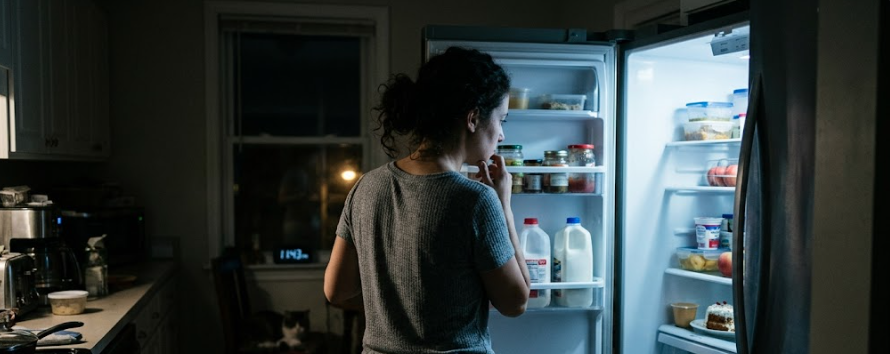
Does this sound familiar?
“I do great all day. Healthy breakfast, decent lunch, skip the afternoon snack I don’t really need. And then 8 pm hits, and I can’t stop eating. I eat until I feel sick and then go to bed feeling like a failure.”
“I have no problem with food during the day. My willpower just disappears at night. I don’t understand what’s wrong with me.”
If you recognize yourself in either of those, I want you to hear something clearly before we go any further: there is nothing wrong with you. What you’re experiencing isn’t a character flaw, a discipline problem, or evidence that you’re “addicted to food.” It is a predictable, physiological response to the way you’ve been eating – and it has a real explanation.
I’ve sat across from hundreds of clients who describe this exact pattern. High achievers. Athletes. People who are disciplined in every other area of their lives and cannot figure out why food feels like the one thing they can’t control. Almost every single time, the answer is the same. And it has nothing to do with willpower.
The Real Reason You Overeat at Night
Your body keeps a running tab.
All day long, while you’re navigating meetings and workouts and traffic and everything else, your body is quietly tracking how much energy has come in versus how much has gone out. It doesn’t moralize. It doesn’t care that you had a salad for lunch because you want to feel good in your race kit. It’s just doing the math.
When the deficit gets large enough — and for most people who overeat at night, it gets large enough every single day — your hunger hormones stop being polite about it. Ghrelin, the hormone that drives hunger, surges. Leptin, the hormone that signals fullness, drops. Your brain’s reward system shifts toward high-calorie, high-palatability foods. Your self-regulation weakens. And the carefully constructed “healthy eating day” you built crumbles, not because you lack discipline, but because your body is doing exactly what a body in an energy deficit is designed to do.
It’s not failure. It’s physiology.
What the Research Shows
Studies on caloric restriction consistently show that the greater the daytime energy deficit, the more pronounced the evening eating response. The brain’s reward pathway becomes significantly more reactive to food cues when the body is underfueled — meaning food actually looks and smells more appealing when you’re running a deficit. This isn’t imagination. It’s a measurable neurological change.
Research also shows that people who distribute their calories more evenly throughout the day report lower food preoccupation, better mood stability, and — critically — less overall intake in the evenings. The “eat less during the day” strategy reliably produces the opposite of its intended effect.
Three Specific Reasons This Happens — And What Each One Means
01 – You’re Chronically Underfueling During the Day
This is the most common driver by far. When your total intake over the course of the day falls significantly below what your body needs – especially when you’re also training – you accumulate an energy debt that has to be settled. The evening meal rarely settles it fully, and the surplus eating that follows is the body collecting what it’s owed.
The fix isn’t complicated, but it requires undoing a belief that many people have held for years: that eating less during the day is a good strategy. It isn’t. It reliably produces more eating overall – just concentrated in the hours when you’re most likely to feel worst about it.
If you’re an active person training two to five times per week, your daily energy needs are likely higher than you’ve been told by any generic meal plan or calorie calculator. Underfueling in athletes is one of the most misunderstood and underdiagnosed issues I see in practice.
02 – Restriction Creates Preoccupation
When the brain perceives scarcity, it redirects attention toward food. This is a survival mechanism so old and so deeply wired that no amount of intellectual resolve overrides it. You can know, logically, that you’ve eaten today. You can know you’re not in any danger. Your brain doesn’t care. It’s operating on primal programming, and that programming says: when energy is low, prioritize finding food.
This is why people who eat very restrictively during the day often describe feeling obsessed with food. Planning the next meal. Fantasizing about specific foods. Finding it hard to concentrate on anything else in the late afternoon. That mental noise isn’t a sign that you “love food too much.” It’s a sign that your brain is doing its job, and your body needs more fuel.
Restriction also specifically increases the appeal of high-fat, high-sugar foods — the exact foods most people are trying to avoid. Research has repeatedly shown that food restriction makes palatable foods more neurologically rewarding, not less. The more you try to avoid something from a place of deprivation, the louder it gets.
03 – Stress, Decompression, and Habit Are All Playing a Role Too
For most people, nighttime eating is partly physiological and partly habitual — and the two reinforce each other in ways that make the pattern feel impossible to break.
Evening is when the structure of the day dissolves. The responsibilities that kept you “on track” fall away. Your nervous system, which has been in some version of high alert all day, is finally trying to wind down. And eating – especially palatable, easy food – is genuinely soothing. It’s not a character flaw. It’s a reasonable response to a difficult day, and the body’s drive for reward and comfort is strongest when we’re depleted.
The problem is that when this happens in the context of physical underfueling, the biological drive and the emotional drive stack on top of each other and become very difficult to separate. Many people describe feeling genuinely unable to stop once they start — and that loss of control is deeply distressing.
Addressing the physiological piece, eating adequately during the day, tends to significantly reduce the emotional component as well. When you’re not running on a deficit, you can actually feel the difference between physical hunger and the desire for comfort. And you have enough cognitive and emotional resources to respond to stress in other ways.
A Reframe Worth Sitting With
Most people come to me trying to fix their nighttime eating. What they actually need to fix is their daytime eating. The evening isn’t where the problem lives — it’s where the problem becomes visible.
This is genuinely good news. Because it means the solution isn’t deprivation, more restriction, or finding some deeper reserve of willpower you’ve somehow been holding back. It means you get to eat more. Earlier. And give your body what it’s been asking for all along.
What to Actually Do About It
If the cycle above sounds like your day, here’s where to start. These aren’t rules — they’re experiments to run and notice the results of.
Eat a real breakfast within 90 minutes of waking
Even if you’re not hungry. Especially if you’re training that morning. A carbohydrate-forward meal — oats, toast with eggs, a smoothie with some substance to it — sets your blood sugar up for a stable morning instead of a crash that primes the restrict-binge cycle before noon.
Don’t go more than 4–5 hours without eating during the day
Long gaps between meals are one of the most reliable predictors of evening overeating. An afternoon snack isn’t a weakness — it’s deficit prevention. Keep the tab from getting so large that your body needs to collect it all at once.
Stop reducing carbohydrates as a daytime strategy
Carbohydrates are the brain’s primary fuel source. When you restrict them during the day, you’re running your most energy-hungry organ on fumes — and it will seek replenishment. This is especially true for anyone who trains regularly. Carbs are not the enemy of your goals. Underfueling is.
Notice what happens to your evening eating when you do all of the above
Most people are surprised by this. When you consistently eat enough during the day, the pull toward nighttime eating genuinely diminishes – not through willpower, but because the biological drive behind it has been addressed at its source. Your hunger cues start to feel manageable. Food starts to feel neutral again.
If you’ve tried these things and the pattern persists, or if the eating feels genuinely compulsive and distressing rather than just habitual, that’s a signal that the restrict-binge cycle has become more entrenched and that working with a professional who understands both the nutritional and psychological dimensions will serve you far better than continuing to try to white-knuckle through it alone.
That isn’t failure either. That’s just knowing when to call in the right support.
You Don’t Have to Figure This Out Alone
If this pattern has been your norm for a long time, a single conversation can often clarify more than months of trying to fix it yourself. A free 20-minute connect call costs you nothing and it might change how you see this entirely.
No pressure. No pitch. Just a real conversation about what’s going on and whether we’d be a good fit.
Frequently Asked Questions
Why am I hungrier at night even when I’ve eaten enough during the day?
If you’re genuinely eating enough during the day and still experience strong evening hunger, there are a few other possibilities worth exploring: eating too quickly during meals (outpacing your fullness signals), high stress levels that affect appetite regulation, disrupted sleep that raises ghrelin, or in some cases, specific macronutrient imbalances, particularly too little protein or fat at meals, which shortens the satiety window. This is the kind of individual nuance that’s hard to address with general advice; a registered dietitian can look at your full picture.
What should I eat at night if I’m genuinely hungry?
Eat something. Seriously. Trying to white-knuckle through genuine physical hunger before bed typically disrupts sleep, accelerates the cycle the next day, and accomplishes nothing except making you more miserable. If your goal is to feel satisfied without feeling overly full at bedtime, a small snack with both protein and carbohydrates – Greek yogurt, a piece of toast with nut butter, a handful of crackers with cheese – tends to settle hunger more effectively than either alone.
Can intuitive eating help with nighttime overeating?
Yes – and this is actually one of the areas where the principles of intuitive eating are most directly applicable. Learning to honor hunger consistently throughout the day, neutralizing the “forbidden food” quality of the foods you tend to overeat at night, and building a more trusting relationship with your body’s signals all directly address the pattern. Most people who work through this process find that the nighttime pull toward food diminishes significantly as their daytime fueling improves and their food relationship heals.
I work out in the evenings. Could that be contributing to nighttime hunger?
Absolutely. Evening training is a perfectly valid choice, but it does mean your body’s refuveling window overlaps with the time of day you’re already most vulnerable to large hunger signals. If you train in the evening and then don’t eat a meaningful recovery meal afterward, you’re compounding an already significant deficit right before bed. A proper post-workout meal, not just a protein shake, is important for evening exercisers. If you find you’re eating a large meal and still feeling unsatisfied, it’s worth looking at whether you’re adequately fueled for training going into those sessions as well.